|
As a mom, you juggle a million things. The school run, work deadlines, dinner—and somehow, you also need to ensure your child has a solid financial foundation for their future. The idea of investing can feel like just another overwhelming chore, full of confusing terms and high-risk gambles. But what if it wasn’t?
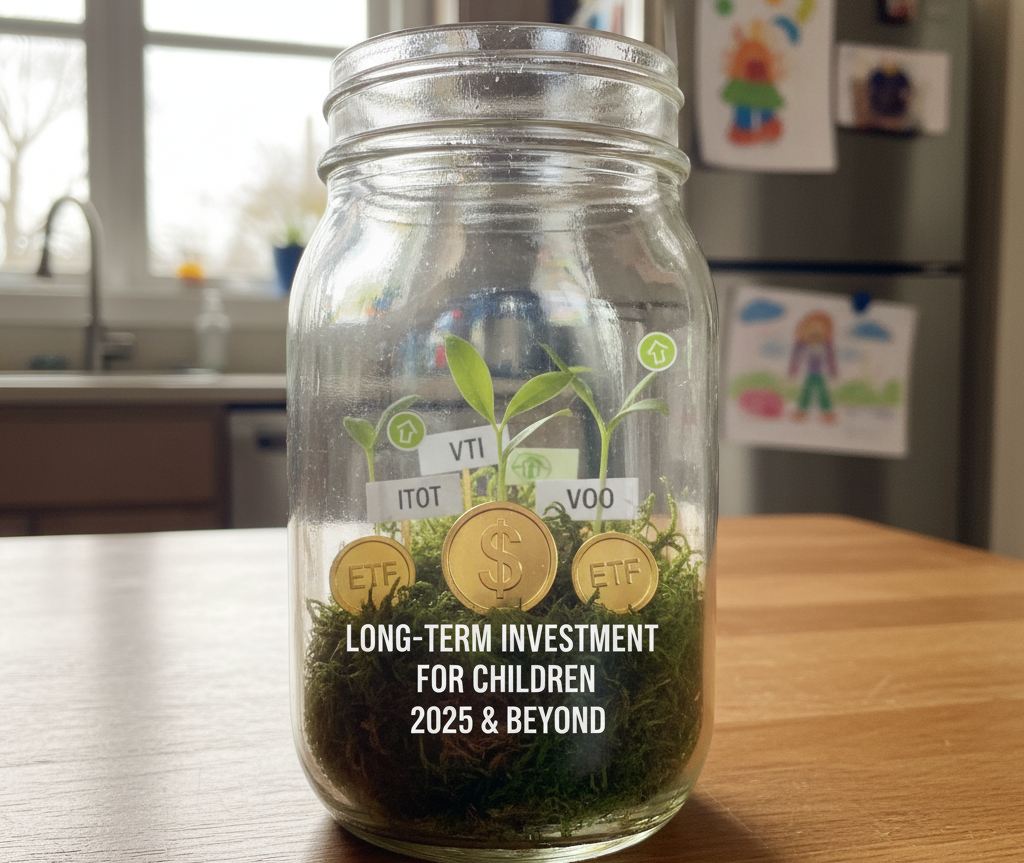
Investing for your child’s future should be simple, effective, and require minimal upkeep. Enter Exchange-Traded Funds (ETFs). These brilliant investment tools are the ultimate financial life-hack for busy parents. They offer instant diversification, are notoriously low-cost, and perfectly align with the core principle of long-term wealth: set it, forget it, and let compounding do the magic.
This comprehensive guide is designed to cut through the jargon. We're focusing exclusively on the best, most reliable long-term ETFs for child accounts, giving you a positive, non-judgmental, and crystal-clear roadmap to securing a brighter tomorrow for your little one.
The Power of Long-Term ETFs for Child’s Future
Before we dive into the specific funds, let's understand why ETFs, especially for a child, are a superior choice over individual stocks or high-fee mutual funds.
1. Instant Diversification
Imagine trying to build a child’s portfolio by buying individual stocks. You'd need dozens of companies to properly spread the risk. With a single ETF, you instantly purchase a tiny share of hundreds or even thousands of companies.
- Example: Buying one share of the Vanguard Total Stock Market ETF (VTI) gives you ownership in over 3,500 companies, from giants like Apple and Microsoft to smaller U.S. firms. If one company fails, the overall impact on your child's portfolio is negligible. This robust diversification is the first line of defense for a successful long-term ETF for child strategy.
2. Low Costs Save Decades of Money
Every dollar paid in fees is a dollar not compounding for your child. The massive advantage of core, index-tracking ETFs is their ultra-low Expense Ratio (ER). This is the annual fee you pay to the fund manager.
- The Math: A difference of just 0.50% in fees per year seems small, but over an 18-year timeframe, this could easily cost your child tens of thousands of dollars in lost returns. The ETFs recommended here have expense ratios often under 0.05%, meaning almost all of your money stays invested and growing. Low-cost is non-negotiable for any successful long-term ETF for child portfolio.
3. Simplicity and Automation
As a busy mom, you don’t have time to research quarterly earnings reports. ETFs, especially those tracking broad indices, are designed to be passively managed. You choose the fund once, set up an automatic monthly investment (known as dollar-cost averaging), and that's it. It's a completely hands-off approach that eliminates stress and ensures consistency—a key to winning the long game. This simplified process truly simplifies life for the mom.
Top 4 Best Long-Term ETFs for Child Investment
For a simple, effective, and stress-free long-term portfolio, you only need to choose one or two of these core funds. They represent the best, most diversified, and lowest-cost options available globally.
1. The U.S. Market Leader: VOO / IVV / SPLG (S&P 500 Tracking)
- Full Name: ETFs tracking the S&P 500 Index (e.g., Vanguard S&P 500 ETF, iShares Core S&P 500 ETF, SPDR Portfolio S&P 500 ETF).
- What it is: The S&P 500 tracks 500 of the largest, most established publicly traded companies in the United States. It's often viewed as the single best proxy for the health and growth of the American economy.
- Why it’s a great long-term ETF for child:
- Historical Performance: The S&P 500 has averaged approximately 10% annual returns over the very long term, a phenomenal rate for a child’s timeline.
- Reliability: These are the titans of industry—Apple, Microsoft, Google, Amazon. They are highly stable and the first to recover after market downturns.
- Cost: Expense ratios are typically a rock-bottom 0.03%.
- Mom’s Advantage: This is the ultimate "set-it-and-forget-it" cornerstone. Because of the long time horizon, you can comfortably ride out market volatility knowing the U.S. economy has historically grown over every multi-decade period. It's the least stressful option.
2. The Global Champion: VT (Vanguard Total World Stock ETF)
- Full Name: Vanguard Total World Stock ETF (VT)
- What it is: This single fund gives you exposure to the entire global stock market—both U.S. and international developed and emerging markets. It holds over 9,000 stocks worldwide.
- Why it’s a great long-term ETF for child:
- Maximum Diversification: You are truly betting on the growth of the entire world economy, eliminating the risk of one country or region lagging behind over two decades.
- Automatic Rebalancing: It automatically adjusts the balance between U.S. and international stocks based on their global market capitalization, meaning you never have to manually rebalance this core holding.
- Mom’s Advantage: This fund is perfect for the truly minimalist investor. If you only want to buy one ETF for your child, VT is the best choice. It maximizes diversification and minimizes decision-making, significantly simplifying your financial life.
3. The Growth Engine: QQQM (Invesco NASDAQ 100 ETF)
- Full Name: Invesco NASDAQ 100 ETF (mini) (QQQM)
- What it is: Tracks the NASDAQ 100, which is heavily weighted toward non-financial growth and technology companies like Tesla, Nvidia, Adobe, and the "Magnificent Seven" (though it excludes financial stocks).
- Why it’s a great long-term ETF for child:
- High Growth Potential: Due to its focus on disruptive and dominant technology, it often outperforms the broader market during periods of tech expansion.
- Long Time Horizon: A child’s portfolio has 15-20+ years, making it perfectly suited to handle the higher volatility of growth-focused funds in pursuit of higher long-term returns.
- Mom’s Advantage: While more volatile than VOO or VT, adding QQQM as a smaller percentage (perhaps 10-20%) of the portfolio gives you the potential for a powerful "growth kick." QQQM is simply the lower-priced version of the famous QQQ, making it a better choice for small, regular investments.
4. The Stability and Income Play: SCHD (Schwab U.S. Dividend Equity ETF)
- Full Name: Schwab U.S. Dividend Equity ETF (SCHD)
- What it is: Focuses on high-quality companies with a long track record of consistently paying and increasing their dividends. It’s a mix of value stocks with a history of financial health (e.g., Home Depot, Coca-Cola, PepsiCo).
- Why it’s a great long-term ETF for child:
- Compound Income: Every quarter, the fund pays out dividends. If you set your account to automatically reinvest these dividends, they buy more shares of SCHD, which then generate even more dividends. This powerful snowball effect turbocharges compounding over a long time horizon.
- Lower Volatility: Dividend-paying companies tend to be mature and profitable, acting as a smoother ballast during market corrections than pure growth stocks.
- Mom’s Advantage: Watching your child’s investment value drop during a market crash can be stressful. SCHD continues to pay dividends even during a downturn, offering a psychological comfort that your portfolio is still "earning" and compounding, simplifying life for the mom by providing a steady, positive data point regardless of market noise.
Setting Up the Long-Term ETF for Child Portfolio: Practical Steps for Moms
The specific investment vehicle you use for your child will depend on your country’s tax laws (e.g., 529 Plans, UTMA/UGMA Custodial Accounts, or Junior ISAs/JIAs). Regardless of the container, the investment process remains the same.
Step 1: Choose the Account Type
The investment vehicle determines the tax treatment.
- Custodial Account (UTMA/UGMA): Assets are legally owned by the child but managed by you until they reach the "age of majority" (18 or 21, depending on the state). Pros: High flexibility, no restrictions on how the money is spent (college, car, business). Cons: Unfavorable tax treatment for the child after a certain income level; assets counted heavily against the child for college financial aid.
- 529 College Savings Plan: Specifically for educational expenses. Pros: Contributions may be tax-deductible (state level), all growth is tax-free if used for qualified education expenses. Cons: Penalties if money is used for non-education expenses; less flexibility.
- Roth IRA (for Children with Earned Income): If your child is a working teenager (even babysitting or mowing lawns), you can open a custodial Roth IRA. Pros: Unbelievable power—tax-free growth forever! Contributions can be withdrawn tax- and penalty-free at any time. Cons: Only contribution limits equal to their annual earned income.
Step 2: Determine Your Allocation (The Easy Way)
Forget complicated formulas. For a child with an 18+ year timeline, the approach should be aggressive—focusing almost entirely on stocks (ETFs). The long time horizon mitigates the risk.
Here are two simple, effective, and positive portfolio blueprints:
Blueprint A: The Minimalist (Maximum Simplicity)
- 100% VT (Vanguard Total World Stock ETF)
- Why it’s great for a mom: This is the easiest portfolio on the planet. You buy one thing, set up a recurring contribution, and literally never check it again for a decade. Maximum diversification, minimum stress.
Blueprint B: The Power-Growth Combo (Maximum Return Potential)
- 70% VOO (S&P 500 ETF)
- 20% VT (Total World Stock ETF)
- 10% SCHD (Dividend Growth ETF)
- Why it’s great for a mom: This gives you a diversified core, a hedge against U.S. market weakness, and the psychological boost of rising dividends. It’s still simple, only requiring three ETFs, and covers the best of the U.S. and global markets.
Step 3: Automate, Automate, Automate
This is the key to simplifying life for the mom. Log into your brokerage account, link your bank account, and set up a recurring, automatic purchase of your chosen ETFs (e.g., $50 every two weeks).
- The Benefit: This enforces Dollar-Cost Averaging (DCA), meaning you automatically buy more shares when the price is low and fewer when the price is high. It removes all emotional decision-making, which is the number one cause of poor investor returns. Your money goes to work automatically, effortlessly, and without requiring any emotional energy from you.
Expanding the Long-Term ETFs for Child Horizon: Sector and Future Bets
While the core ETFs listed above are perfect for 90% of the portfolio, for a little fun or a slightly more aggressive tilt, consider these targeted long-term ETFs for child accounts. Use these for no more than 10-15% of the total investment to maintain a low-risk profile.
The Innovation Bet: VGT / XLK (Technology Focused)
- Vanguard Information Technology ETF (VGT) / Technology Select Sector SPDR Fund (XLK)
- Focus: Core technology sector giants. These funds have historically crushed the market due to the rapid growth of companies like Apple and Microsoft, which represent a significant portion of their holdings. Betting on technology for a multi-decade horizon is essentially betting on progress itself.
The Next Generation: ARKK / Global X ETFs (Thematic Investing)
- Focus: While more volatile and expensive, thematic ETFs focus on disruptive trends like Artificial Intelligence, Robotics, Genomics, and Clean Energy.
- Caution for Mom: These require a higher risk tolerance and may underperform for years before experiencing high growth. They should only be used as a small, "fun money" part of a long-term portfolio after establishing a strong foundation with the core, low-cost options (VOO, VT).
The Inflation Hedge: GLDM / IAU (Gold ETFs)
- Focus: Tracks the price of physical gold.
- Why it can be useful: Gold is considered an inflation hedge and tends to perform well when confidence in paper money is low. While it doesn't pay dividends or grow like a company, a tiny allocation (say, 5%) can stabilize the portfolio during severe market crises, offering peace of mind.
Final Mom-to-Mom Advice on Long-Term ETFs for Child
Remember, the goal here is not to become a financial wizard. It's to be a smart, efficient mom who uses the best tools available to build a strong future for her child without adding to her own mountain of stress.
The biggest secret to success is consistency and time. A small, automatic investment every month, year after year, will outperform large, sporadic investments driven by emotion every single time. Start small, be consistent, and trust the power of the market's long-term upward trend. You've already made the best decision simply by starting this research.
You got this. Your child's future is looking bright.
Conclusion
Choosing the best long-term ETFs for child investment does not need to be complicated. By focusing on low-cost, broadly diversified funds like the S&P 500 (VOO) and the Total World Stock ETF (VT), you are setting the stage for decades of effortless compounding. This set-and-forget strategy—simple to execute, cheap to maintain, and highly effective over the long run—is the ultimate way to simplify life for the mom while simultaneously securing a powerful financial advantage for the next generation. Start today, automate your contributions, and then relax knowing you’ve done a magnificent job preparing them for the journey ahead.
|